Top Tips for Navigating the CASP License Poland Requirements
Need to obtain a CASP license in Poland? This article explains the requirements, key dates, eligibility criteria, and the step-by-step process to apply. Follow these guidelines to ensure your crypto business operates legally.
Key Takeaways
Companies in Poland must obtain a CASP license to legally provide cryptocurrency services, adhering to the rigorous MiCA regulations to ensure user protection and compliance.
Key deadlines, such as submitting CASP applications by May 1, 2025, and the dissolution of the VASP Register on October 1, 2025, are crucial for maintaining operations during the regulatory transition.
Applicants must establish a local presence and demonstrate compliance with capital requirements, legal standards, and detailed documentation for successful CASP license acquisition.
Understanding the CASP License in Poland
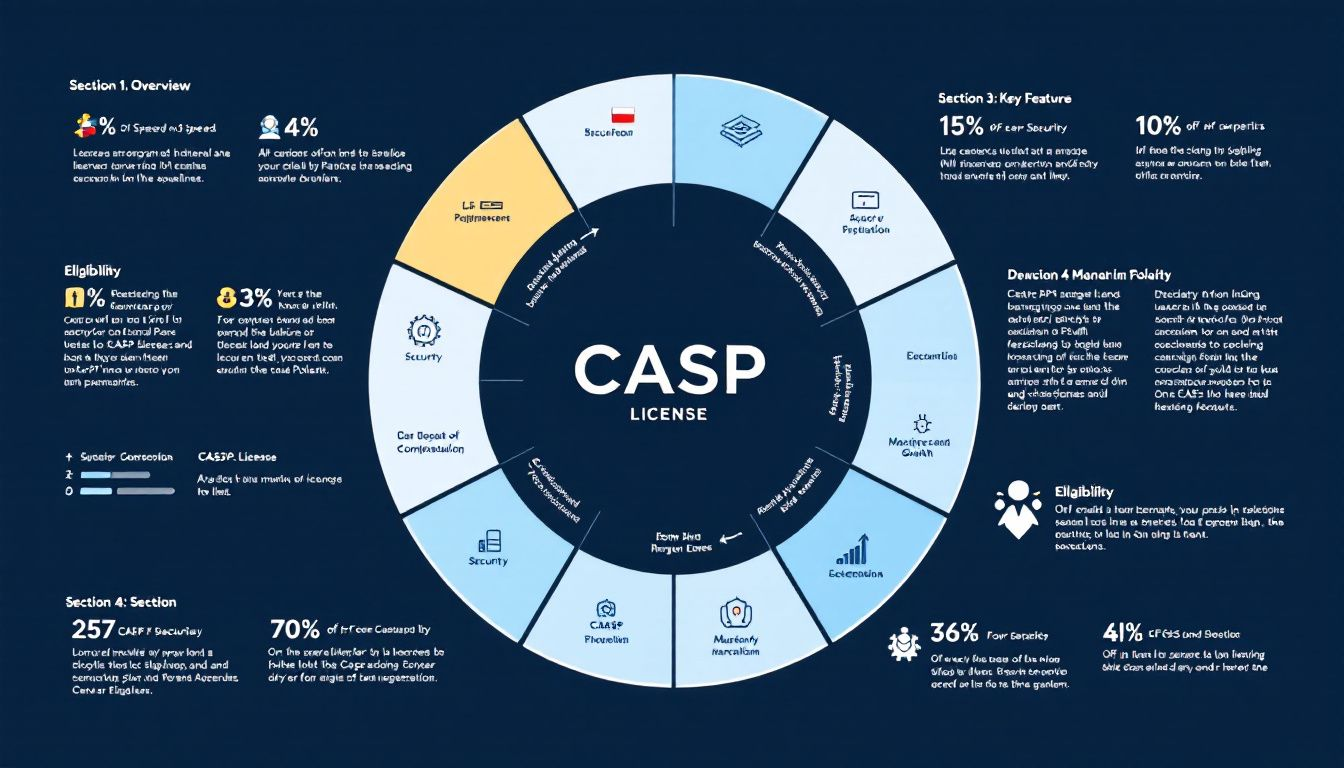
Possessing a CASP license is vital for firms to administer cryptocurrency services within the European Union, aligning with MiCA regulations that safeguard users. This crypto license harmonizes criteria and norms across various regions to promote transparency and bolster security in the digital asset market. Essential for Polish enterprises operating with cryptocurrencies, it authorizes them to provide an array of such services throughout the EU legally.
The procedure for obtaining a CASP license entails an exhaustive evaluation ensuring applicant companies conform to established operational standards which encompass custody solutions, trading platform oversight, portfolio management capabilities, and precise execution of orders. Conformity with these stipulated norms is crucial as it ensures adherence to European Union directives while also building client confidence alongside trust among other interested parties.
In anticipation of acquiring this essential permit, Polish entities dealing in cryptocurrencies must engage diligently in preliminary preparations focused on comprehending what’s mandated by regulators as well as collating all pertinent paperwork. Doing so facilitates a more seamless adjustment into functioning according to guidelines outlined under the auspices of CASP certification—preserving their edge within both competitive and compliant spheres of influence. The role played by the Polish Financial Supervision Authority cannot be understated. They are tasked with validating candidate suitability against rigorous MiCA regulatory requirements during this entire process.
Key Dates for MiCA Regulation and CASP Licensing
From December 30, 2024, virtual asset service providers (VASPs) in the EU will have to adhere to MiCA regulations — a significant moment for those within the European crypto industry looking to offer services under this updated legal structure. The Polish register for VASPs is set to be abolished on October 1, 2025, heralding the consolidation into a more centralized regulatory regime.
Registered VASPs as of December 30, 2024 are permitted to maintain their operations according to existing norms until they either secure a CASP license or receive a notice of rejection by June 30, 2025 at the latest. To avoid any disruption in providing services, these entities should lodge a comprehensive application for CASP licensing no later than May first of that same year.
The final date by which Polish-based virtual asset service providers must apply for re-licensure under CASP terms underscores an urgent call towards compliance and preparation. It falls on June thirty-five, two thousand twenty-five. The pivot date is December thirty-four, twenty-four: post this date, no new applications from cryptocurrency businesses will be accepted within Poland.
It’s imperative during this interim phase that companies currently recognized with VASP status prepare themselves adequately for acquiring their CASP licenses. This includes tailoring internal protocols and ensuring alignment with upcoming MiCA standards – essential preparations needed if Polish firms operating in cryptocurrencies wish not only comply but also thrive amidst newly emerging frameworks regulating their sector.
Eligibility Criteria for CASP License Applicants
Beginning the process to acquire a CASP license in Poland necessitates forming a local company, which includes establishing an entity with its registered office situated within the European Union, specifically including Poland as an option. The governing body of this entity must comprise at least two directors on the Management Board, one of whom is required to reside within EU borders to guarantee substantial presence and accountability in that region.
Those serving on the management board are expected to be individuals of commendable character, endowed with adequate proficiency, capabilities, and experience essential for proficiently guiding the firm. Significant stakeholders are obligated to present a comprehensive structure chart displaying ownership and voting rights particulars so as to affirm transparency. These shareholders must demonstrate clean legal records by verifying they have not been indicted for offenses tied to money laundering or financing terrorism – measures put forth to preserve both integrity and public perception of legitimacy.
During their CASP licensing application submission phase alongside ongoing operations post-licensing approval. Applicants including key personnel such as members on management boards along with significant shareholders are mandated consistently prove adherence to lawful benchmarks involving personal conduct without any criminal infractions related directly to them.
The enforcement of this stringent screening protocol ensures only organizations adhering strictly toward superior standards regarding governance paired together with moral business practices will successfully complete obtaining their respective casp licenses throughout Polish jurisdiction territories.
Required Documentation for CASP License Application
It is essential to compile all necessary documents when applying for a CASP license. The application must show evidence of well-defined internal governance and operational strategies, which include policies on outsourcing, business continuity plans, oversight frameworks, procedures for internal control and risk management, ICT system structures, the separation of customer’s crypto assets from company funds, processes for handling complaints, and explanations of commercial guidelines. These records offer a thorough insight into the firm’s functionality and adherence to regulatory stipulations.
The extent of documentation required is contingent upon the services that will be provided under the MiCA license. For example, in instances where custodial services are offered. It becomes imperative to detail out custody administration protocols. Descriptions should also cover operational regulations applicable to trading platforms being used by clients along with non-prejudicial policies related to client interactions as well as ensuring clearly laid out asset segregation methods aligning with compliance expectations set forth by MiCA standards.
Diligent organization and presentation of these important documents signify an entity’s dedication towards meeting regulated norms effectively. This meticulousness is fundamental in securing approval for a CASP license indicating robust enterprise functioning while safeguarding customers’ interests within the realm of crypto assets transactions.
Capital Requirements for Different Crypto Asset Services

Firms aiming to provide crypto asset services with a CASP license must adhere to specified capital requirements that correspond to the scope of their operations. These stipulations are designed as safeguards, mandating adequate financial backing for the secure and sound provision of these services. The spectrum of intended service offerings dictates the minimum capital requirements for prospective CASPs.
Operating a trading platform dedicated to crypto assets necessitates holding the most substantial amount at €150,000 in own funds—a reflection of such platforms’ integral role within the crypto market infrastructure and their need for considerable fiscal solidity. Conversely, entities offering supplementary services like execution of orders, converting one form of crypto asset into another or traditional currencies, providing advisory assistance on investments or administering digital wallets face a reduced but still significant requirement: they must possess no less than €50,000 in own funds—ensuring operational viability even among smaller players within this burgeoning sector.
Engaging in additional functions encompassing safeguarding clients’ crypto assets alongside managing those holdings comes with an increased threshold—an own fund mandate set at EUR 125K. Compliance can be demonstrated via retention equivalent liquid assets internally (own funds), securing suitable insurance coverage against risks encountered by customers dealing with such firms—or employing both strategies concurrently. This tiered framework asserts that all participants engaged in any type of activities relating directly or indirectly to rendering distinct Crypto Asset Transfer Services or broader Cryptocurrency-Centric Activities remain financially equipped. Ensuring robust delivery standards underpin each interaction between providers—the ‘crypto asset service provider(s)’—and their clientele utilizing said mechanisms (services).
Step-by-Step Guide to CASP License Application
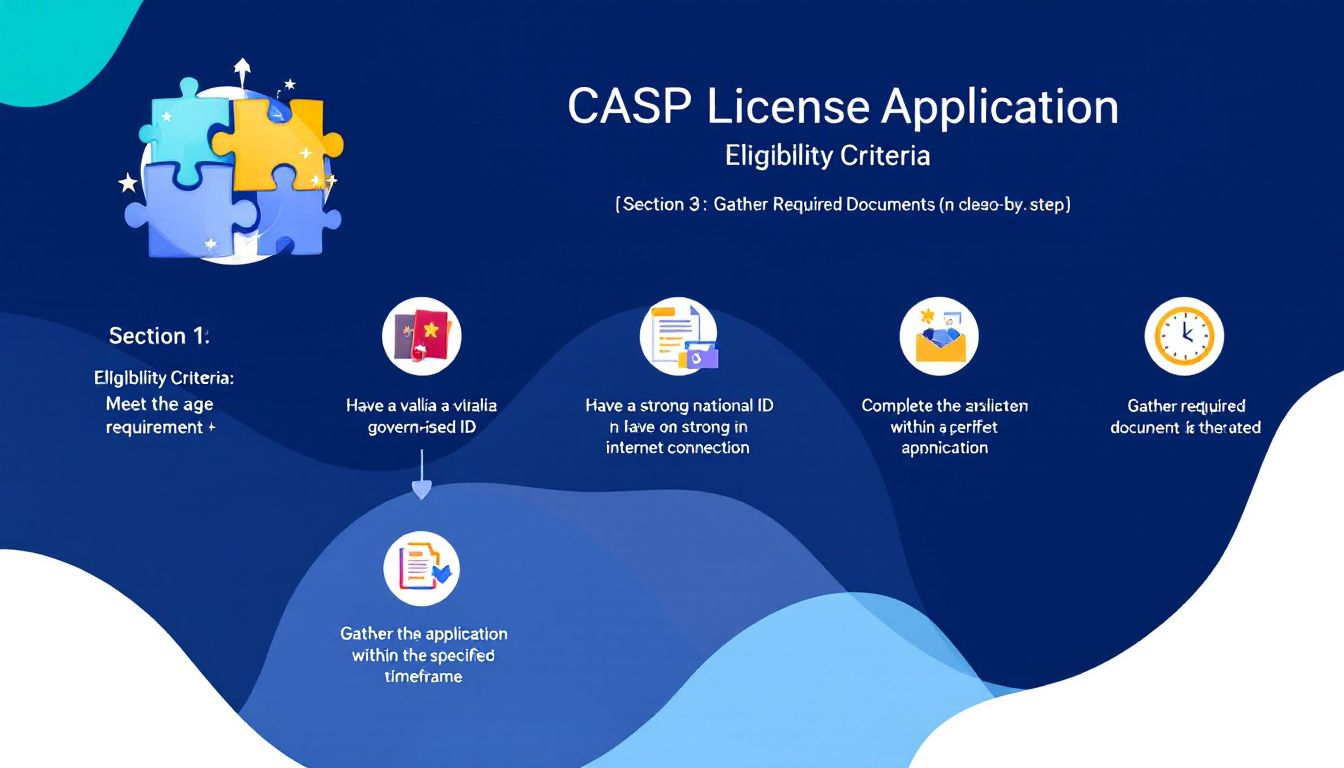
Commencing the CASP license application necessitates initial legal due diligence focusing on the services that will be encapsulated by the CASP. It is crucial to formulate a business model in strict accordance with MiCA regulations and any pertinent national legislation, as various stipulations are contingent upon the specific services rendered.
Subsequent to laying this groundwork, one must proceed with submitting their application to the appropriate regulatory body. This step initiates an exhaustive evaluation process conducted by said authority.
Preparing Your Application
Acquiring a CASP license begins with the meticulous assembly and submission of detailed documentation that demonstrates adherence to MiCA regulations. This encompasses establishing internal procedures, formulating policies, and producing evidence of sound corporate governance practices. The thoroughness and compliance of these documents are pivotal in effectively progressing through the CASP licensing process.
The act of preparing for licensure necessitates the compilation of crucial documents such as an Outsourcing Policy, Business Continuity Plan, and outlines detailing governance strategies. These records offer a holistic depiction of the company’s operational framework and its dedication to meeting regulatory expectations. Diligent preparation is essential to ensure that the application is exhaustive and satisfies all stipulated regulatory criteria.
Submitting Your Application
After receiving the CASP application, the Polish Financial Supervision Authority (Komisja Nadzoru Finansowego) will send an acknowledgment within five business days. It is essential to provide a complete application with all necessary documents and information to the appropriate supervisory authority.
This action is vital to commence the evaluation procedure.
Review and Assessment Process
The examination procedure begins with a thorough inspection for completeness, verifying the submission of all mandated documentation. Should any essential elements be missing from an application, applicants will receive a specified period within which they must rectify these shortcomings. This phase guarantees that each application adheres to established prerequisites prior to progression.
Upon receipt of an exhaustive application, the designated regulatory body is obligated to deliver its verdict within a span of 40 days. It is imperative for applicants to provide detailed technical descriptions pertaining to their ICT systems and security protocols in language accessible to those without technical expertise.
This meticulous evaluation protocol ensures that only entities fulfilling every compliance criterion are granted the privilege of holding a CASP license.
Compliance and Ongoing Obligations
Holders of a CASP license are required to abide by AML/CFT guidelines as a means of thwarting financial crime, which includes the obligation to report any suspect activities and transactions without delay. Adhering to the Travel Rule Regulation (EU Regulation 2023/1113) is equally obligatory for CASPs, necessitating that they gather and exchange certain details about transactions with the aim of bolstering transparency.
In line with the Digital Operational Resilience Act, it’s imperative for CASPs to put in place strong cybersecurity safeguards along with risk management strategies aimed at securing their operational infrastructure and safeguarding client information. Continual audits and evaluations are necessary to verify compliance consistently over time, upholding both integrity within the crypto market ecosystem as well as its overall security.
Should there be any deviation from MiCA regulations on behalf of CASPs, considerable penalties might be enforced by EU national regulators. This can also extend to criminal charges against senior staff members involved. Non-adherence may interfere with services, leading potentially to restrictions in operating within European markets. For these reasons, maintaining regulatory compliance is vital for not only ensuring legal operations but also sustaining success for a Crypto Asset Service Provider (CASP).
Common Challenges and How to Overcome Them
Navigating the complexities of the CASP licensing process often entails overcoming significant hurdles such as executing initial legal due diligence and establishing stringent ICT security protocols. To successfully traverse this terrain, seeking out expert legal and professional advice is indispensable for composing requisite documents and performing compliance reviews.
Overlooking comprehensive legal due diligence or misjudging the importance of ICT security measures are typical oversights that can derail a company’s efforts to secure a CASP license. Proactive strategies aimed at these challenges not only smooth out the case license application journey but also minimize risks, thereby aligning with all mandated regulatory standards and increasing chances for a favorable outcome in obtaining licensure.
Operating Cross-Border with a CASP License
The concept of passporting enables entities with a license to offer their services throughout the European Union by relying on the authorization from their country of origin. This system, particularly within the scope of a CASP license, permits the smooth distribution of crypto services among EU member states without requiring multiple individual licenses for each jurisdiction. Such an arrangement greatly streamlines regulatory duties for Crypto Asset Service Providers (CASPs) that are active in various countries.
In order to extend their services beyond national borders within the EU, CASPs must communicate with relevant authorities in those nations where they wish to operate. Possessing a CASP license substantially strengthens a service provider’s capacity to provide offerings across Europe while adhering to local laws and leveraging an integrated regulatory structure. This ability to traverse borders provides substantial leverage for CASPs as it facilitates widening their customer base and market influence.
Reverse Solicitation and Its Implications
Under MiCA, reverse solicitation allows non-EU crypto asset service providers to operate without licensing if the EU client independently requests services. This provision requires service providers to maintain comprehensive documentation of client communications to validate their claims of reverse solicitation compliance. Disclaimers in contracts cannot negate the requirements of reverse solicitation, emphasizing the importance of genuine client-initiated requests.
Reverse solicitation allows non-EU CASPs to provide services within the EU without obtaining a local license. However, the burden of proof lies with the service provider, who must ensure all client requests are genuinely unsolicited. This requires meticulous record-keeping and adherence to regulatory standards.
Impact of Non-Compliance
Non-adherence to the Markets in Crypto-Assets Regulation (MiCA) may result in substantial repercussions, such as hefty monetary penalties and the possibility of criminal charges. The inability to comply could interrupt services and restrict crypto businesses from functioning within the European Union market, underlining the critical need for MiCA compliance.
Authorities are empowered to impose sanctions and administrative actions on entities that violate MiCA provisions, affecting how crypto assets service providers (CASPs) operate. Consequently, it is crucial for these businesses to fulfill regulatory requirements in order to preserve their legal status and ensure operational integrity, thereby safeguarding both themselves and their customers from negative outcomes associated with non-compliance.
Summary
Embarking on the journey to obtain a CASP license in Poland demands meticulous preparation, consistent adherence to compliance deadlines, and sustained vigilance. It is imperative that companies comprehend important milestones and qualification prerequisites while compiling all required paperwork and satisfying mandated capital provisions for an efficacious application for a CASP license. Adhering strictly to MiCA regulations and preemptively tackling typical obstacles are fundamental steps for firms aiming to establish their position within the dynamic crypto market. Approach this process with assurance. Recognizing that diligent groundwork coupled with strict observance of regulatory norms will lay down the foundations for triumph.